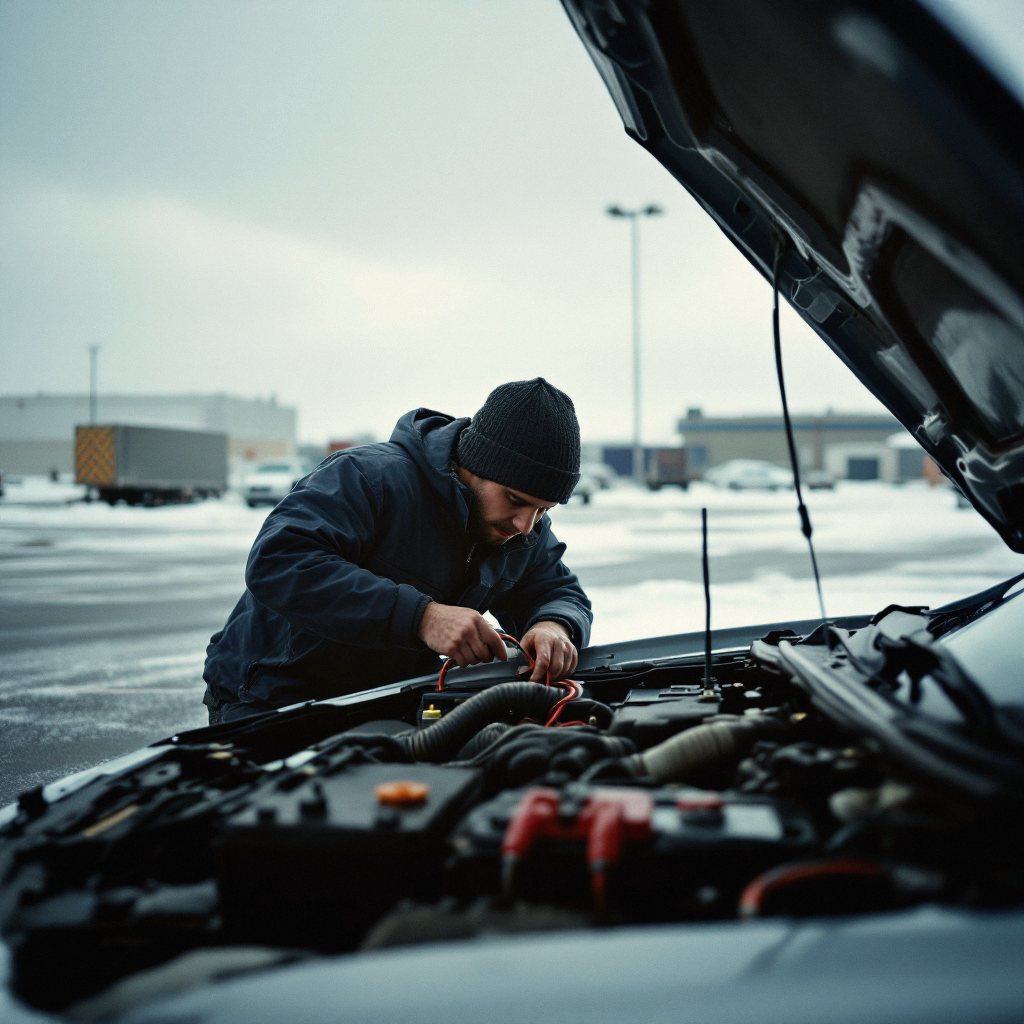
Half the calls we get end with your car driving away — jump, unlock, tire swap or a few gallons of fuel. Cheaper than a tow, faster than a network.
Call (317) 747-2955 Non-Urgent RequestSpeed and honesty. The 800-number auctions your call and quotes hour-plus waits; we're 20–40 minutes out. And a local truck has no incentive to convert a $60 jump into a $150 tow — the review you leave lives on our actual name. Use your coverage anyway: pay us, submit the receipt, get reimbursed. Same money, half the wait.
Twenty to forty minutes to most addresses in Fishers, Geist and the near side of Noblesville, and the honest version of that number has a few conditions on it. Weather moves it. A January morning after an ice event puts every truck in Hamilton County on a queue, and anybody promising you twenty minutes in those conditions is guessing. Time of day moves it too, though less than people expect, because the calls cluster at commute hours on both ends and at bar close on weekends.
What does not move it is where you sit in a call centre's auction. That is the real difference between calling us and calling the number on the back of an insurance card. A national roadside network takes your call, converts it into a job ticket, and shops that ticket to whichever operator will take it cheapest. You wait through the shopping. Then you wait for the winner to finish whatever they were already doing. The hour-plus waits people complain about are almost never one slow truck. They are the auction.
Call a local number and you are talking to the person who knows where the truck is. If we are forty minutes out, we say forty minutes, and if we are the wrong call entirely we say that as well. On a cold shoulder on 96th Street, an accurate number is worth more than an optimistic one.
Most on-the-spot calls in the core service area run $50 to $85, and the spread inside that range is mostly time of day and how far off the main roads you are. Fuel delivery adds the cost of the fuel. Winch-outs depend on how far into the ditch the vehicle went and whether we need a second point of pull, so those get quoted after we can see it or after you describe it properly.
Two things worth knowing before you call anyone. First, a roadside fee that folds into a tow is not standard everywhere, and it should be. If we come out for a jump, the battery is finished, and the car needs to go to a shop anyway, you should not be paying for two dispatches on the same visit. Ours folds in. Ask whoever you call whether theirs does.
Second, use your coverage. If you carry roadside through your insurance, an auto club or a card benefit, most policies reimburse a receipt from an independent operator. Pay us, send the receipt, get the money back. You get the local response time and the coverage you already pay for, which is a better trade than sitting in a queue to protect a benefit you can claim either way. Check your specific policy language, because the reimbursement rules vary and we cannot tell you what your carrier will accept.
Roughly a third of the jump calls we run are on batteries that are finished, and the jump is a way to move the problem to tomorrow morning. A battery that dies twice in a week, that cranks slowly when the car has been sitting for only a few hours, or that is more than four or five years old in an Indiana climate is usually telling you something. We will test it rather than just clamp it, and if it is done we say so. Selling somebody a second jump start is a bad way to earn a review.
There are also cases where the battery is fine and the jump is masking something else. An alternator that has stopped charging will start on a jump and die again a few miles down the road, which is a considerably worse place to be than a parking lot. If the car started, ran, and then quit while driving, tell us that on the phone. It changes what we bring and it changes the advice.
And there is the case where a jump is genuinely unsafe. A battery that is swollen, leaking, or has visible damage to the case does not get jumped. Neither does a hybrid or electric vehicle with a dead traction battery, which is a different job entirely and usually a flatbed one. If you are not sure what you are looking at, describe it and let us decide.
Get out of the traffic lane if the vehicle can move at all, even if it means the shoulder rather than the ramp you wanted. If it cannot move, stay belted in with the hazards on rather than standing beside the car on a highway shoulder. On I-69 in particular, standing outside a disabled vehicle is the most dangerous thing most people do all year.
Turn the hazards on and, if you have them, put reflective triangles or flares well back up the road. Well back means further than feels necessary at highway speed. If it is dark and cold, keep the interior light off and stay in the car with a coat on rather than running the engine for heat if you smell fuel or see steam.
Have your location ready before you dial. The nearest cross street, mile marker or the address of whatever business you can see beats a dropped pin that puts you on the wrong side of a divided road. Have the make, model and colour of the vehicle ready too, and tell us if you are in a garage with a height restriction, because that changes which truck comes.
The core is Fishers and Geist, where we are closest and fastest. From there the coverage runs north into Noblesville, out along the I-69 corridor in both directions, and into the surrounding Hamilton County communities. Geist gets its own attention because the lake roads and private drives confuse GPS routing badly, and knowing which entrance actually gets a truck to a given cul-de-sac saves fifteen minutes on a call.
If a roadside fix is not going to hold, the same truck handles the tow. Light recovery from a ditch or a snowbank is roadside work; anything deeper, on its side, or involving damage becomes accident recovery. Vehicles that cannot roll, are all-wheel drive, or are low enough to scrape go on the flatbed. If it is the middle of the night and the car simply has to move now, that is emergency towing, and what that costs is laid out on the towing cost page rather than left for the invoice.
Call (317) 747-2955 Now Schedule a Tow
